

Golden Torch Cactus for Sale
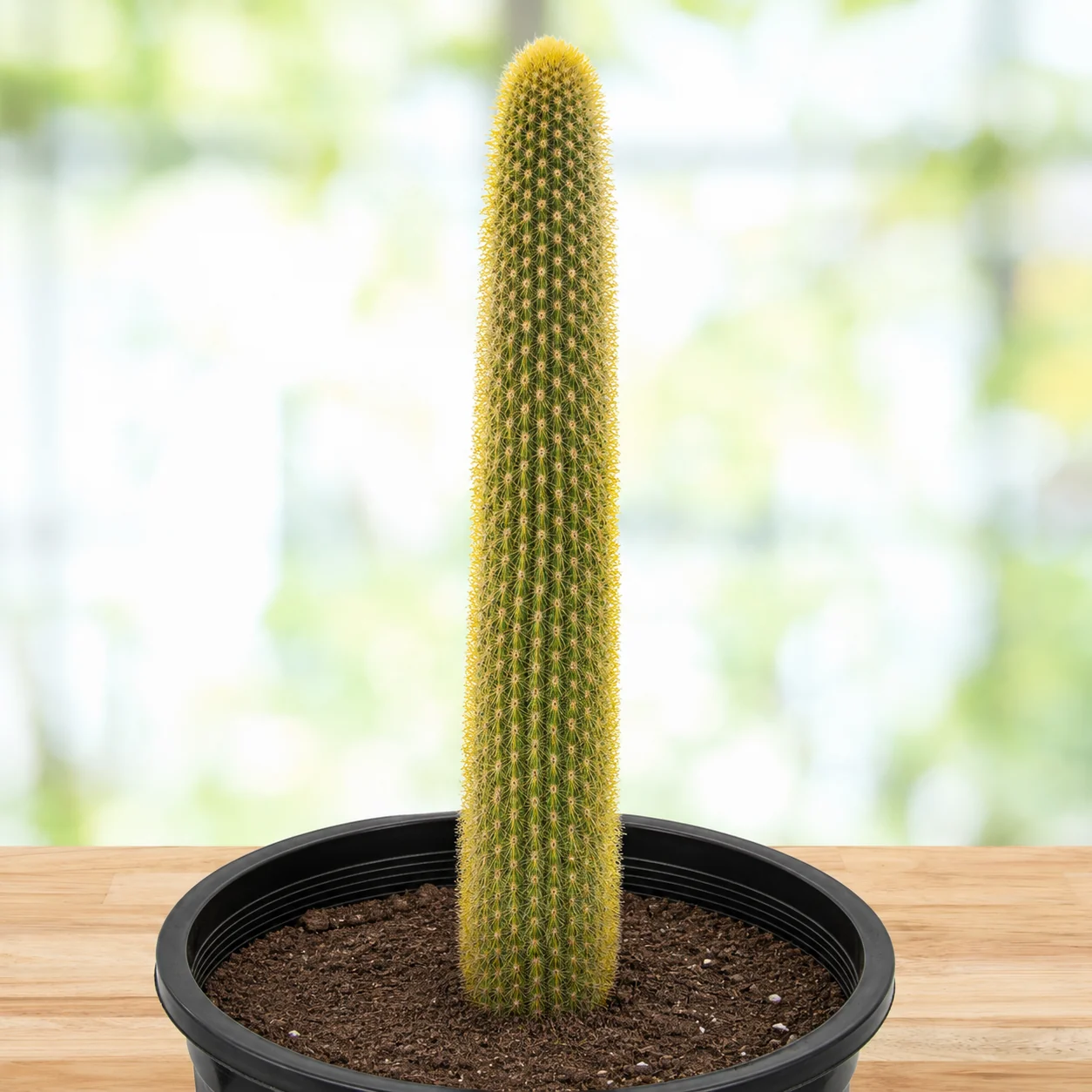
The Golden Torch Cactus (Echinopsis spachiana) is a tall, clustering columnar cactus distinguished by its upright green stems, orderly ribs, and rows of golden-yellow to yellow-brown spines. Young plants create a clean vertical accent, while established specimens can produce additional columns from the base, gradually developing into an impressive multi-stemmed cluster.
Its golden spination provides year-round character, but mature plants have another attraction: large white flowers that open at night, creating a dramatic contrast against the narrow, heavily ribbed stems.
For growers looking for a columnar cactus that combines height, clustering growth, golden spines, and spectacular mature flowering, Golden Torch offers a particularly strong combination.
Echinopsis spachiana — The Golden Torch Cactus
The currently accepted botanical name is:
Echinopsis spachiana
However, this species has moved through several botanical classifications.
Many cactus growers still recognize it as:
Trichocereus spachianus
and Soehrensia spachiana may also appear in botanical references.
Kew currently accepts Echinopsis spachiana and treats both Trichocereus spachianus and Soehrensia spachiana as synonyms.
These different names therefore do not automatically indicate different plants.
For buyers comparing nursery labels, older cactus references, and contemporary botanical databases, recognizing the synonymy can prevent considerable confusion.
What Makes Golden Torch Cactus Recognizable?
Golden Torch has the classic vertical structure associated with South American columnar cacti, but several characteristics give it a clear identity.
Its stems are:
- tall and cylindrical;
- prominently ribbed;
- green to darker green;
- lined with regularly positioned areoles;
- armed with yellow to golden-brown spines;
- capable of producing additional columns from the base.
The combination of slender green columns and warm-colored spination creates the golden appearance behind its common names Golden Torch and Golden Column.
RHS describes mature plants as multi-stemmed and shrubby, with cylindrical ribbed stems produced from the base.
That basal growth is important because it changes the plant’s appearance substantially with age.
From One Column to a Cluster
A young Golden Torch Cactus may look relatively simple.
It can begin as a single upright column without the clustered appearance associated with older specimens.
Over time, additional shoots can emerge from around the base.
Those stems grow vertically beside the original column, gradually creating a group of parallel torches.
This development gives Echinopsis spachiana a different mature architecture from columnar species that remain primarily solitary or develop heavy tree-like branches higher on the plant.
The specimen becomes fuller by adding new columns from below.
For collectors, this means a compact young Golden Torch has considerable potential to become structurally more interesting as it matures.
Golden Torch Cactus vs. Silver Torch Cactus
Their common names sound closely related, but these are distinct cactus species.
Golden Torch Cactus is Echinopsis spachiana.
Silver Torch Cactus is Cleistocactus strausii.
Golden Torch develops green ribbed stems with conspicuous yellow to golden-brown spines.
Silver Torch is covered much more densely with fine white spines, creating its characteristic silver-white appearance.
Their flowers are also notably different.
Mature Golden Torch plants produce large white nocturnal flowers, while Silver Torch is known for narrower reddish tubular flowers.
For accurate identification, botanical names are far more useful than relying on the word “torch” alone.
Choosing a Golden Torch Cactus
The right plant depends partly on whether you want immediate structure or prefer to develop a specimen over time.
Consider the Number of Stems
A single-column plant usually represents a younger or simpler growth stage.
A specimen already producing basal stems provides a fuller appearance immediately.
Both can develop attractively.
Look at the Spination
Golden-yellow to yellow-brown spines are characteristic of the species and create much of its ornamental appeal.
Exact spine length, density, and coloration can vary between individual plants.
Consider the Height
A smaller plant is easier to position, repot, and develop over time.
A taller specimen provides stronger immediate vertical impact but requires greater attention to stability and growing space.
Plan for Future Growth
Golden Torch is not naturally a miniature cactus.
RHS describes mature specimens reaching approximately 1.5–2.5 meters in height under its referenced cultivation conditions.
Consider future vertical space when selecting a permanent location.
Check the Individual Listing
Exact height, stem diameter, number of columns, container size, rooting status, propagation method, flowering status, and whether photographs represent the exact specimen are inventory-specific characteristics.
These should be verified from the individual product rather than inferred from general species information.
The Golden Spines
The name Golden Torch comes primarily from the relationship between stem and spine.
Each cylindrical stem is divided into vertical ribs. Large areoles sit at regular intervals along those ribs, producing clusters of yellowish to golden-brown spines.
The pattern becomes particularly attractive when viewed along the length of the plant because the repeated areoles create organized vertical lines.
Unlike Silver Torch Cactus, the spines do not completely obscure the green stem.
Both elements remain visible:
green column + golden spination.
That contrast gives the species its characteristic appearance throughout the year, regardless of whether the plant is flowering.
Large White Flowers That Open at Night
Flowering changes the appearance of a mature Golden Torch dramatically.
Established Echinopsis spachiana can produce large white flowers that open at night. RHS records the flowers in midsummer, while Gardening Australia also describes the species’ nocturnal white blooms.
The flowers emerge from the sides of developed stems and are proportionally large compared with the narrow columns supporting them.
Their pale color and nighttime opening create a striking contrast with the green stems and golden spines.
Flowering is associated with maturity and appropriate growing conditions.
A young plant should therefore be selected primarily for its structure and long-term development rather than with the expectation of immediate flowers.
Current flowering status should only be stated when verified for the individual specimen.
How Large Does Golden Torch Cactus Grow?
Golden Torch develops considerably more height than a typical globular or barrel cactus.
RHS describes the species as reaching approximately 1.5–2.5 meters tall, with a spread of roughly 0.5–1 meter under its referenced conditions.
Individual stems remain relatively narrow compared with their eventual height.
This creates an upright silhouette even when several stems develop together.
Container cultivation can keep the plant more manageable, while outdoor specimens in appropriate climates have greater opportunity to express their natural clustered form.
Its eventual dimensions should still be considered before positioning it permanently near paths, structures, or other plants.
How to Grow Golden Torch Cactus
Light
Golden Torch performs best with abundant light.
RHS recommends full sun, and strong light helps maintain sturdy, compact columnar growth.
A plant previously grown under greenhouse shade or another protected environment should be introduced gradually to substantially stronger direct sunlight.
This acclimation helps reduce the risk of sun damage.
Soil & Drainage
Excellent drainage is fundamental.
Use a porous cactus growing medium that allows excess water to leave the root zone efficiently.
RHS specifies well-drained growing conditions, and Gardening Australia similarly recommends well-drained soil and warns against allowing the plant to sit in water.
Containers should always have functional drainage openings.
Watering
Water according to actual growing conditions rather than an inflexible schedule.
During active growth, provide appropriate moisture and then allow the growing medium to dry sufficiently before watering again.
Avoid prolonged saturation around the roots.
Temperature, sunlight, season, airflow, container size, plant size, and substrate all influence how quickly moisture is used.
Water requirements generally decrease as conditions become cooler and growth slows.
Golden Torch Cactus in Containers
The upright growth of Echinopsis spachiana makes it particularly effective as a container specimen while manageable in size.
A relatively small footprint can support considerable vertical growth.
As the cactus becomes taller or begins producing additional basal stems, however, container stability becomes increasingly important.
The pot should provide:
- reliable drainage;
- adequate root space;
- enough weight and stability for tall stems;
- room for developing basal growth.
Avoid automatically moving a small cactus into an excessively large container, since a large volume of slow-drying substrate can complicate moisture management.
Container growing is especially useful in colder climates because the plant can be moved into protection when seasonal conditions become unsuitable.
Golden Torch Cactus in the Landscape
In suitable climates, Golden Torch can become an impressive vertical landscape specimen.
Its clustered columns work particularly well in:
- cactus gardens;
- rock gardens;
- xeric landscapes;
- succulent beds;
- architectural planting schemes;
- desert-inspired gardens.
A mature cluster creates greater visual impact than a single stem while retaining a relatively narrow, upright profile.
Give the plant sufficient room for additional basal stems to develop.
Also consider its spines when positioning it near walkways, seating areas, or other places where regular physical contact could occur.
Native Range & Natural Habitat
Golden Torch is a South American cactus.
Kew records the native range of Echinopsis spachiana from Bolivia to northwestern Argentina, where the species occurs primarily in desert or dry shrubland environments.
That background helps explain several of its cultivation preferences: abundant light, free drainage, and sensitivity to prolonged waterlogging.
Its South American origin also distinguishes it geographically from many familiar Mexican and North American columnar cacti.
Natural Variation Between Golden Torch Plants
Individual plants should not be expected to look identical.
Natural differences can occur in:
- stem height;
- stem thickness;
- number of basal shoots;
- rib definition;
- spine length;
- golden or yellow-brown spine coloration;
- growth direction;
- overall symmetry;
- minor cosmetic markings.
Age creates even greater differences.
A young single column can look dramatically simpler than an established multi-stemmed cluster while still being the same species.
Exact dimensions, number of stems, container size, rooting status, propagation method, and current flowering condition should therefore come from the specific product listing.
A Torch That Becomes a Cluster
Golden Torch Cactus becomes more interesting as its architecture develops.
A young plant may begin with one straightforward ribbed column. Then another stem can emerge from the base. And another.
Over time, that progression transforms a simple vertical cactus into a cluster of upright green columns lined with warm golden spines.
Mature plants add something even more dramatic: large white flowers opening against those spiny stems at night.
That combination gives Echinopsis spachiana a strong identity among columnar cacti.
Choose a Golden Torch Cactus when you want upright growth, golden spination, natural basal clustering, and a specimen capable of becoming substantially more impressive with age.
Frequently Asked Questions About Golden Torch Cactus
What is the scientific name of Golden Torch Cactus?
The accepted botanical name is Echinopsis spachiana. Kew treats Trichocereus spachianus and Soehrensia spachiana as synonyms.
Is Golden Torch Cactus the same as Trichocereus spachianus?
Yes. Trichocereus spachianus is an older botanical combination currently treated by Kew as a synonym of Echinopsis spachiana.
Where is Golden Torch Cactus native?
Kew records its native range from Bolivia to northwestern Argentina.
How tall does Golden Torch Cactus grow?
RHS gives an ultimate height range of approximately 1.5–2.5 meters under its referenced cultivation conditions. Actual size depends on climate, growing environment, container culture, and maturity.
Does Golden Torch Cactus produce multiple stems?
Yes. Established plants can produce new columns from the base, eventually developing into multi-stemmed clusters.
Does Golden Torch Cactus flower?
Yes. Mature specimens can produce large white flowers that open at night. Flowering depends on plant maturity and suitable growing conditions.
Is Golden Torch the same as Silver Torch Cactus?
No. Golden Torch is Echinopsis spachiana, while Silver Torch is Cleistocactus strausii. Their spination, overall appearance, and flowers are notably different.
Can Golden Torch Cactus grow in a container?
Yes. Its upright habit makes it suitable for container cultivation, particularly while young or moderately sized. Provide abundant light, excellent drainage, and increasing container stability as the plant gains height.
Does Golden Torch Cactus need full sun?
It performs well in full sun. Plants previously grown under protected conditions should be acclimated gradually before receiving substantially stronger direct sunlight.
| Size | 12"-18" Tall Plant, 36"+ Tall Plant |
|---|
Be the first to review “Golden Torch Cactus”
Related products
Cactus for sale
Cactus for sale
SAN PEDRO DRIED SKIN / 30GR AT 2KG / – (TRICHOCEREUS PACHANOI CACTUS) HUACHUMA WACHUMA ECHINOPSIS
Cactus for sale
Cactus for sale
Cactus for sale
Cactus for sale
San Pedro Pachanoi (Trichocereus) In Pot Large 25 CM – 40 CM
Cactus for sale
Trichocereus pachanoi – cristata (San Pedro) In soil – Small
Cactus for sale
Reviews
There are no reviews yet.