Golden Barrel Cactus For Sale
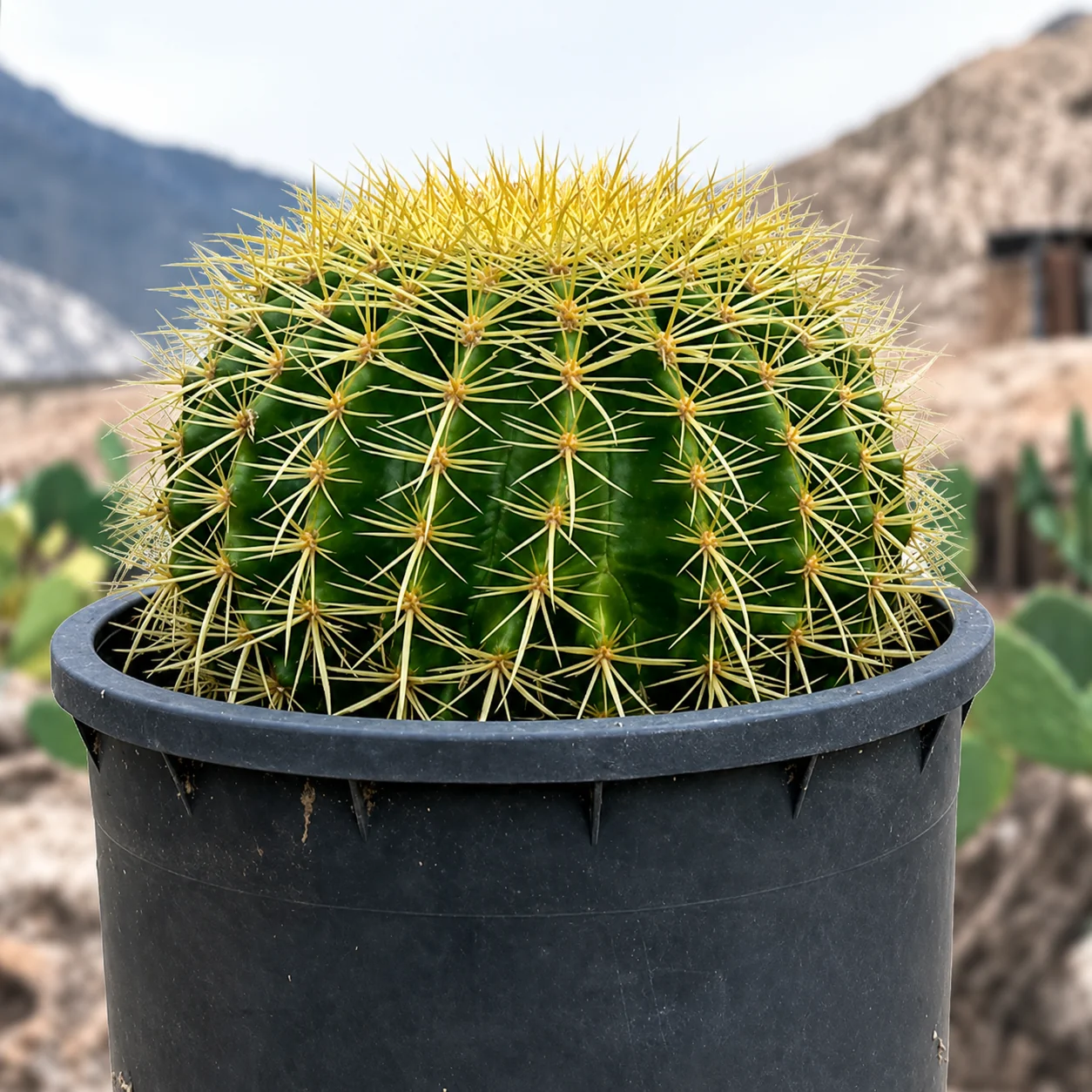
The Golden Barrel Cactus (Kroenleinia grusonii, syn. Echinocactus grusonii) is one of the most recognizable barrel cacti, combining a rounded, deeply ribbed body with dense golden-yellow spines arranged in remarkably orderly rows. Young plants begin almost spherical, while established specimens gradually become broader and more substantial without losing the strong geometric character that makes the species immediately recognizable.
Native to Mexico, this slow-growing cactus works beautifully as a standalone container specimen, within a curated cactus collection, or as a bold architectural accent in suitable dry landscapes.
Choose a Golden Barrel Cactus for sale when you want a cactus whose impact comes from symmetry, structure, and brilliant golden spination.
The Golden Barrel Cactus — Understanding Its Botanical Name
Golden Barrel Cactus has long been known in horticulture as Echinocactus grusonii, and that remains the botanical name buyers are most likely to encounter on nursery labels and plant listings.
Current taxonomy deserves a little clarification.
Kew’s Plants of the World Online currently accepts:
Kroenleinia grusonii
and treats:
Echinocactus grusonii
as a synonym.
Both names therefore refer to the Golden Barrel Cactus discussed on this page.
For shoppers comparing plants across nurseries and botanical references, recognizing both names is considerably more useful than pretending only one is encountered in cultivation.
Why Golden Barrel Cactus Is So Recognizable
Its appeal begins with geometry.
Young specimens develop a compact globular body divided into pronounced vertical ribs. Along those ribs sit regularly spaced areoles carrying clusters of yellow to golden spines.
As the plant matures, additional ribs develop and the body becomes increasingly substantial.
Oklahoma State University describes mature plants as having 20 or more ribs, with clusters of golden-yellow spines arising from yellow areoles.
Seen from above, the combination of ribs, areoles, and radiating spines creates an exceptionally ordered pattern.
Seen from the side, the dense golden spination emphasizes the rounded barrel form.
Few cacti combine both qualities so effectively.
Choosing a Golden Barrel Cactus
The best specimen for you depends partly on where you intend to grow it and how developed you want the plant to be at purchase.
Consider the Size
Smaller Golden Barrel Cacti have a compact, almost spherical appearance and provide the opportunity to watch the rib structure become increasingly pronounced over time.
Larger specimens create greater immediate impact but also require more container or landscape space.
Look at the Form
Golden Barrel Cactus is naturally valued for its rounded, symmetrical development.
Living plants will still vary slightly, however, and minor differences in proportions or growth should be expected.
Consider the Spination
The classic form develops yellow to golden spines that become one of the plant’s strongest visual features.
Spine density and exact coloration can vary somewhat with age and growing conditions.
Decide Between Container and Landscape Growing
A smaller plant can remain an impressive container specimen for years because the species develops relatively slowly.
In an appropriate warm, dry climate, Golden Barrel Cactus can also mature into a substantial landscape accent.
Check the Individual Product
Exact diameter, height, container size, rooting status, age, propagation method, and whether photographs represent the exact specimen are inventory-specific characteristics.
Confirm those details from the individual product listing rather than assuming them from general species information.
How Large Does Golden Barrel Cactus Get?
Golden Barrel Cactus is slow growing, but it should not be mistaken for a permanently miniature cactus.
Established specimens can eventually become substantial.
Oklahoma State University describes plants around 2 feet high and 2.5 feet in diameter, while other mature specimens can reach roughly 3 feet under favorable conditions.
That size develops gradually.
The Royal Horticultural Society estimates approximately 10–20 years to ultimate size under its referenced cultivation conditions, illustrating why this species is often considered a long-term specimen rather than a fast-changing plant.
For container growers, slow development is an advantage: the cactus can maintain a strong architectural presence without rapidly overwhelming its space.
For landscape growers, its eventual dimensions should still be considered when choosing a permanent position.
Golden Spines & Geometric Ribs
The common name tells only half the story.
Yes, the spines are golden.
But their effect depends on the structure beneath them.
Each pronounced rib carries repeated clusters of spines, producing an orderly pattern around the entire body of the cactus. As the number of ribs increases with maturity, that pattern becomes progressively denser and more complex.
Strong light can make the yellow spines particularly striking, emphasizing their contrast against the green cactus body.
This is why Golden Barrel Cactus works so well as a specimen plant.
Its appearance is visually interesting from virtually every direction rather than depending on a single flowering period or viewing angle.
Does Golden Barrel Cactus Flower?
Yes, but flowering is primarily a feature of sufficiently mature specimens.
Established Golden Barrel Cacti can develop yellow flowers around the crown of the plant. The blooms emerge near the woolly apex rather than along the lower body.
A young nursery plant should not automatically be expected to flower.
Maturity, light, and growing conditions influence flowering, so current bloom status should only be stated when verified for the individual specimen.
For most of the plant’s life, its ornamental value comes principally from its rounded geometry and golden spines rather than flowers.
How to Grow Golden Barrel Cactus
Light
Golden Barrel Cactus performs best with abundant light.
Full sun supports strong, compact growth and the characteristic appearance of the species.
However, newly purchased plants should be treated according to their previous growing conditions.
A cactus raised under greenhouse shade or filtered light can be damaged if moved immediately into intense sun. Increase exposure gradually when necessary.
Soil & Drainage
Excellent drainage is essential.
Use a porous cactus substrate that allows excess water to move quickly away from the roots.
Oklahoma State University specifically identifies very well-drained soil as the preferred condition for the species.
Containers should always have functional drainage openings.
For landscape cultivation, avoid depressions or heavy soils where moisture remains around the roots for extended periods.
Watering
Golden Barrel Cactus is drought adapted, but good cultivation is not simply a matter of withholding water indefinitely.
During active growth, water appropriately and allow the growing medium to dry well before watering again.
Frequency should change according to temperature, sunlight, airflow, season, container size, and substrate rather than following an inflexible weekly schedule.
During cooler periods when growth slows, moisture demand is substantially reduced.
The most important principle is avoiding prolonged saturation around the roots.
Growing Golden Barrel Cactus in Containers
Few barrel cacti are as naturally suited to specimen-container presentation.
The plant remains relatively compact for a long period, while its radial symmetry means there is no unattractive “back” side that must be hidden.
A stable container is increasingly important as the cactus gains diameter and weight.
Choose a pot that provides adequate root space without surrounding a small root system with an unnecessarily large volume of slow-drying soil.
Excellent drainage remains more important than decorative appearance.
Container cultivation also makes seasonal protection easier in regions where winter temperatures are unsuitable for permanent outdoor growing.
Golden Barrel Cactus in the Landscape
In suitable climates, Golden Barrel Cactus can create an exceptionally strong landscape accent.
A single mature specimen draws attention through its symmetry, while groups can create repeating patterns of rounded forms and golden spines.
It works particularly well in:
- cactus and succulent gardens;
- xeriscapes;
- rock gardens;
- desert-inspired landscapes;
- architectural planting schemes;
- gravel and mineral-based garden designs.
Allow adequate space around each plant so its mature form remains visible and air can circulate freely.
Because the spines are substantial, avoid positioning mature specimens immediately beside narrow walkways or areas where people regularly brush against the plant.
A Species With Conservation Significance
Golden Barrel Cactus is extremely common in cultivation, but its situation in the wild is very different.
The species has historically faced serious pressure in its native Mexican habitat. Kew records it as Endangered under the IUCN assessment included in its database, despite its widespread presence in horticulture.
That distinction matters.
A plant can be common in nurseries while remaining threatened in nature.
For buyers, the responsible approach is straightforward: purchase nursery-propagated plants from legitimate cultivated sources rather than supporting removal of mature specimens from wild populations.
The University of Arizona similarly advises obtaining Golden Barrel Cactus from reputable sellers because of its conservation status in habitat.
Natural Variation Between Golden Barrel Cacti
Golden Barrel Cactus has an unusually orderly growth pattern, but living plants are never manufactured objects.
Individual specimens can vary naturally in:
- diameter;
- height;
- number of developed ribs;
- spine length;
- spine density;
- golden-yellow coloration;
- overall proportions;
- crown development;
- minor cosmetic markings.
Age also changes the appearance considerably.
A juvenile plant with fewer ribs will not look identical to a decades-old specimen with a broad body and densely developed spine pattern.
Product-specific details such as exact dimensions, container size, age, rooting status, and photo representation should therefore come from the individual listing.
A Cactus That Becomes More Impressive With Time
Golden Barrel Cactus does not depend on rapid growth to command attention.
Its appeal develops gradually.
The body expands. The rib structure becomes more pronounced. Additional areoles build increasingly intricate rows across the surface. Golden spines reinforce the geometry until an established plant becomes almost perfectly architectural.
That slow progression is precisely what makes Kroenleinia grusonii such a rewarding specimen.
Whether grown individually in a container or given room to mature in a dry landscape, it offers a combination that relatively few cacti match: strong symmetry, brilliant spination, substantial mature presence, and an instantly recognizable form.
Choose a Golden Barrel Cactus for a collection or landscape where its structure has room to be appreciated—and where a plant that develops character over many years is part of the appeal.
Frequently Asked Questions About Golden Barrel Cactus
What is the scientific name of Golden Barrel Cactus?
Kew currently accepts Kroenleinia grusonii as the botanical name and treats Echinocactus grusonii as a synonym. Echinocactus grusonii remains extremely common in horticultural use.
Where is Golden Barrel Cactus native?
The species is native to Mexico. Kew records its native range from Zacatecas to San Luis Potosí and associates it primarily with desert or dry shrubland environments.
How large does a Golden Barrel Cactus grow?
Mature specimens can reach roughly 2–3 feet in overall dimensions under favorable conditions, although growth is slow and container-grown plants may remain smaller for many years.
How fast does Golden Barrel Cactus grow?
It is a slow-growing cactus. Mature size develops over many years rather than a few growing seasons, making it well suited to growers interested in a long-term specimen.
Can Golden Barrel Cactus grow indoors?
Yes, particularly as a container specimen, but it requires abundant light. One of the brightest suitable positions available is preferable for indoor cultivation.
Does Golden Barrel Cactus need full sun?
The species performs well in full sun. Plants previously grown under protected conditions should be acclimated gradually before being exposed to substantially stronger sunlight.
Does Golden Barrel Cactus flower?
Yes. Sufficiently mature specimens can produce yellow flowers around the crown, typically during the warmer growing season.
Why is my young Golden Barrel Cactus not perfectly barrel-shaped?
Young plants can be more spherical, and their proportions change gradually as they mature. The broad barrel form and increasingly complex rib pattern become more pronounced with age.
Is Golden Barrel Cactus endangered?
The species is widely cultivated, but Kew’s database records an IUCN assessment of Endangered for its wild populations. This is one reason cultivated, nursery-propagated sourcing is important.
| Size | 5" × 5" Plant (1 Gallon), 9" × 9" Plant (5 Gallon), 12" × 15" Plant (10 Gallon), 5 Gal Cluster, 10 Gal Cluster, Cluster A 14"x16" |
|---|
Be the first to review “Golden Barrel Cactus For Sale”
Related products
Cactus for sale
SAN PEDRO / 30GR AT 1KG / – (TRICHOCEREUS / ECHINOPSIS PACHANOI) HUACHUMA – CAPTUS POWDER
Cactus for sale
San Pedro Pachanoi (Trichocereus) In Pot Large 25 CM – 40 CM
Cactus for sale
Cactus for sale
Cactus for sale
Cactus for sale
Cactus for sale
Reviews
There are no reviews yet.