
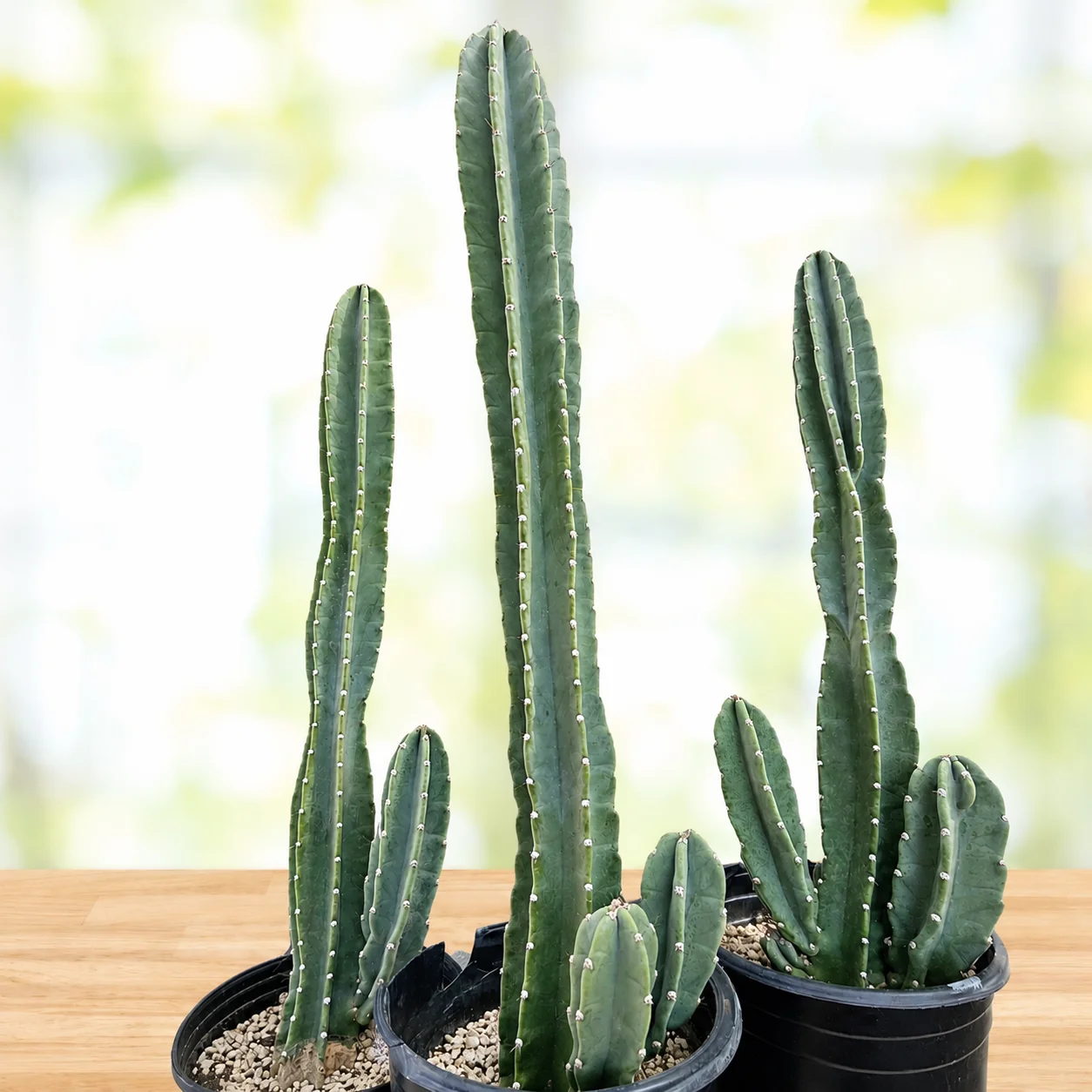


Peruvian Apple Cactus for Sale
The Peruvian Apple Cactus (Cereus repandus) is a vigorous columnar cactus known for its tall blue-green to gray-green stems, pronounced ribs, large nocturnal flowers, and colorful fruit on mature specimens. As it develops, a young upright plant can become a substantial, branching cactus with a bold tree-like silhouette.
Its combination of vertical growth, relatively clean columnar form, spectacular flowers, and fruiting potential makes it an appealing choice for cactus collections, large containers, and warm-climate landscapes.
Choose a Peruvian Apple Cactus for sale when you want a cactus capable of developing genuine scale and architectural presence.
Cereus repandus — The Peruvian Apple Cactus
The accepted botanical name of Peruvian Apple Cactus is:
Cereus repandus
The older name Cereus peruvianus is still widely encountered in horticulture and is currently treated by Kew as a synonym of Cereus repandus.
That distinction is useful when comparing plant labels or researching the species. A cactus offered as Cereus peruvianus may therefore be referring to the same taxon rather than an entirely different plant.
The common name creates another potential source of confusion.
Despite being widely known as Peruvian Apple Cactus, the accepted native distribution reported by Kew is the southern Caribbean and northern South America, from Venezuela to Colombia.
For reliable identification, the botanical name Cereus repandus is more informative than interpreting the common name literally.
What Does Peruvian Apple Cactus Look Like?
This is a cactus built around vertical structure.
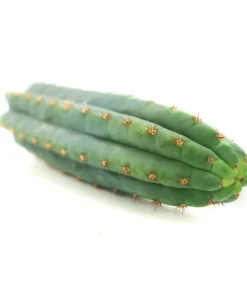
Cereus repandus develops upright cylindrical stems with clearly defined ribs. Stem coloration ranges from gray-green to blue-green, creating a cooler appearance than the bright green found in many other columnar species.
Areoles are positioned along the ribs and can carry variable grayish spines.
The spination is not always visually dominant.
Instead, the plant’s strongest characteristics are usually its:
- tall columnar growth;
- blue-green to gray-green stems;
- pronounced vertical ribs;
- increasingly branched structure;
- large flowers on mature growth;
- colorful fruit under suitable conditions.
Young plants can appear comparatively simple.
As the cactus gains height and branches, its architectural character becomes considerably stronger.
A Columnar Cactus With Serious Mature Size
Peruvian Apple Cactus should not be selected as though it will remain a small windowsill plant indefinitely.
This is naturally a large cactus.
Under favorable conditions, Cereus repandus can develop into a substantial, self-supporting, tree-like specimen with multiple upright branches.
That mature potential is one of its strongest ornamental qualities.
A smaller plant can be maintained in a container while manageable, but buyers planning long-term outdoor cultivation should consider future height, branching, clearance, and available growing space from the beginning.
The right location for a young cactus may not necessarily be the right location for the same plant years later.
Choosing a Peruvian Apple Cactus
The best specimen depends on what you want from the plant.
Consider Height
A smaller cactus is easier to handle and gives you the opportunity to develop the specimen over time.
A taller plant provides more immediate vertical impact.
Look at the Structure
Some plants may consist primarily of a single column, while more established specimens can show branching.
Branching is part of the species’ mature growth habit, so a young unbranched plant should not be considered incomplete.
Consider Stem Color
Blue-green and gray-green tones are characteristic of the species, but exact coloration varies between plants and according to growing conditions.
Plan for Its Future Position
This species has substantially greater mature potential than many small ornamental cacti.
Consider whether the plant will remain container-grown or eventually become part of a warm-climate landscape.
Verify the Individual Plant
Exact height, stem diameter, number of branches, container size, rooting status, propagation method, current flowering or fruiting status, and whether photographs represent the exact specimen are inventory-specific details.
Those characteristics should be confirmed from the individual product listing.
Peruvian Apple Cactus Flowers
The flowers provide a dramatic contrast to the plant’s otherwise structural appearance.
Mature Cereus repandus can produce large cream to white flowers that open at night.
The flowering display can be particularly striking because the blooms emerge from tall ribbed stems rather than from a compact flowering crown.
Individual flowers are relatively short-lived, making flowering a seasonal event rather than a permanent feature of the cactus.
Plant maturity and growing conditions influence whether flowering occurs.
For that reason, a young Peruvian Apple Cactus should be selected primarily for its form and development potential rather than with the expectation of immediate flowers.
Current bloom status should only be stated when verified for the individual plant.
The Fruit Behind the Name
The “apple” portion of Peruvian Apple Cactus refers to its fruit.
Following successful flowering and pollination, mature plants can develop smooth, colorful fruits containing pale flesh and numerous small seeds.
Kew records Cereus repandus as having food uses within its native range.
Fruit production should nevertheless be treated as a mature-plant characteristic rather than a guarantee attached to every specimen.
Plant age, flowering, pollination, climate, and cultivation conditions all influence fruit development.
A young plant may require considerable additional growth before reaching reproductive maturity.
Peruvian Apple Cactus vs. San Pedro Cactus
The two can appear superficially similar to an inexperienced buyer because both are tall, green, ribbed columnar cacti.
They are not the same plant.
Peruvian Apple Cactus is Cereus repandus.
San Pedro Cactus is Echinopsis pachanoi.
Beyond belonging to different genera, their stem structure, areoles, spine characteristics, flowers, fruits, branching habits, and overall mature appearance differ.
For a site carrying several columnar cactus species, botanical naming is therefore especially valuable.
Do not rely on “tall green cactus” as an identification method.
How to Grow Peruvian Apple Cactus
Light
Provide abundant light.
Strong light supports sturdy columnar development and helps maintain the compact proportions expected from a healthy sun-adapted cactus.
If a newly purchased plant has previously been grown under greenhouse shade or filtered conditions, introduce substantially stronger direct sunlight gradually.
Sudden exposure can damage tissue that has not acclimated to intense sun.
Soil & Drainage
Use a porous, fast-draining cactus growing medium.
Water should move efficiently through the root zone rather than remaining trapped around the roots.
Containers require functional drainage openings.
For outdoor cultivation, avoid poorly drained depressions or heavy soils that remain saturated after irrigation or rainfall.
Watering
Water according to the plant’s actual growing conditions.
During active growth, provide water and then allow the substrate to dry appropriately before watering again.
Avoid keeping the root zone continuously wet.
Temperature, sunlight, airflow, container size, plant size, season, and soil composition all affect drying time, making a rigid weekly schedule less useful than checking the substrate itself.
Water requirements generally decline during cooler periods and slower growth.
Growing Peruvian Apple Cactus in Containers
Young and moderately sized specimens can make impressive container plants.
Their upright growth provides height without immediately requiring the horizontal area occupied by sprawling cactus species.
Container cultivation also gives growers greater control over:
- soil composition;
- drainage;
- watering;
- seasonal protection;
- final placement.
As the cactus gains height and branches, stability becomes increasingly important.
Use a container capable of supporting the plant without compromising drainage, and reassess its location as the specimen develops.
A large mature plant may eventually become impractical to move frequently.
Growing Peruvian Apple Cactus Outdoors
Where climate permits, Cereus repandus can become a commanding landscape cactus.
Its vertical columns work particularly well where height and architectural structure are desirable.
Give it adequate room away from confined spaces where mature branches could become problematic.
A suitable planting location should provide:
Strong light. The species is adapted to bright conditions.
Excellent drainage. Persistent root-zone saturation should be avoided.
Growing room. Mature plants can become large and branched.
Appropriate temperatures. This is a tropical dry-region cactus rather than a broadly cold-hardy North American species.
Growers in colder climates can maintain younger plants in containers and provide protection when seasonal temperatures become unsuitable.
Why Young and Mature Plants Look So Different
A young Peruvian Apple Cactus may be little more than a clean, upright column.
That appearance does not fully represent the species’ mature architecture.
With time, established plants can develop additional branches and a much larger framework, eventually taking on a tree-like form.
Flowering and fruiting are also associated with sufficiently mature growth.
This age-related transformation is important when evaluating nursery plants.
A smaller specimen should be considered the beginning of the plant’s architecture rather than a miniature version that will permanently maintain the same proportions.
Natural Variation Between Plants
Individual Cereus repandus specimens naturally vary.
Differences may occur in:
- height;
- stem thickness;
- rib definition;
- blue-green or gray-green coloration;
- spine number and length;
- number of branches;
- growth direction;
- minor surface markings;
- overall symmetry.
Spination in particular can be variable.
Living plants should therefore not be expected to reproduce another specimen’s appearance exactly.
For exact dimensions, branching, container size, rooting status, and current condition, rely on the specifications and photographs attached to the individual product.
Built for Height, Flowers & Long-Term Presence
Peruvian Apple Cactus offers something different from compact globular cacti and miniature collector plants.
It is a cactus with vertical ambition.
A relatively straightforward young column can eventually become a tall, branching specimen whose ribbed blue-green stems create structure throughout the year. Mature growth can add large nocturnal flowers and, under suitable conditions, the colorful fruit responsible for its familiar common name.
That progression gives Cereus repandus long-term value in a collection.
Whether maintained in a container while manageable or given room to develop outdoors in an appropriate climate, its strongest appeal lies in watching a simple column gradually acquire the scale and architecture of a mature specimen.
Choose a Peruvian Apple Cactus when height, structural growth, and long-term specimen development are part of what you want from a cactus.
Frequently Asked Questions About Peruvian Apple Cactus
What is the scientific name of Peruvian Apple Cactus?
The accepted botanical name is Cereus repandus. Kew lists Cereus peruvianus as a synonym, which explains why the older name remains common in horticulture.
Is Peruvian Apple Cactus actually native to Peru?
Despite the common name, Kew currently records the native range of Cereus repandus as the southern Caribbean and from Venezuela to Colombia rather than Peru.
How large does Peruvian Apple Cactus grow?
It is a large, tree-like columnar cactus when mature and given suitable outdoor conditions. Container-grown plants can be maintained at more manageable dimensions, particularly while young.
Does Peruvian Apple Cactus produce fruit?
Mature plants can produce fruit following successful flowering and pollination. Kew records food use for the species. Fruit production depends on maturity and growing conditions and should not be assumed for every plant.
Does Peruvian Apple Cactus flower?
Yes. Mature specimens can produce large pale flowers that open at night. Flowering depends on plant maturity and suitable growing conditions.
Is Peruvian Apple Cactus the same as San Pedro Cactus?
No. Peruvian Apple Cactus is Cereus repandus, while San Pedro Cactus is Echinopsis pachanoi. They are distinct cactus species belonging to different genera.
Can Peruvian Apple Cactus grow indoors?
Yes, particularly while young and manageable as a container specimen. It requires abundant light and enough vertical space for continued growth.
How often should Peruvian Apple Cactus be watered?
Avoid using a fixed schedule. Water appropriately during active growth, then allow the growing medium to dry sufficiently before watering again. Frequency should change with temperature, sunlight, season, airflow, pot size, and substrate.
Is Cereus peruvianus the same as Cereus repandus?
Under Kew’s current taxonomy, Cereus peruvianus is treated as a synonym of the accepted species Cereus repandus.
| Size | 12"-14" Tall Plant, 15"-18" Tall Plant, 20"-24" Tall Plant, 20"-24" Tall Plant, 20"-24" Tall Plant, 20"-24" Tall Plant, 37"-42" Tall Plant, 43"-48" Tall Plant, 60" Tall Plant |
|---|
Be the first to review “Peruvian Apple Cactus”
Related products
Cactus for sale
Cactus for sale
Cactus for sale
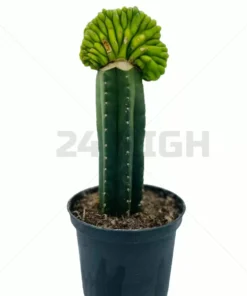
Cactus for sale
San Pedro Pachanoi (Trichocereus) In Pot Large 25 CM – 40 CM
Cactus for sale
SAN PEDRO / 30GR AT 1KG / – (TRICHOCEREUS / ECHINOPSIS PACHANOI) HUACHUMA – CAPTUS POWDER
Cactus for sale
YOPO – VILCA SEEDS / 200gr at 1kg – (Anadenanthera Peregrina) 100% Pure Natural and Organic
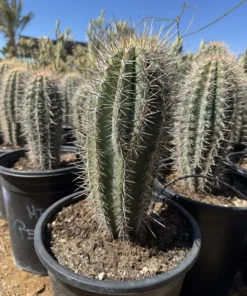
Cactus for sale
Cactus for sale
Reviews
There are no reviews yet.