

Blue Flame Cactus
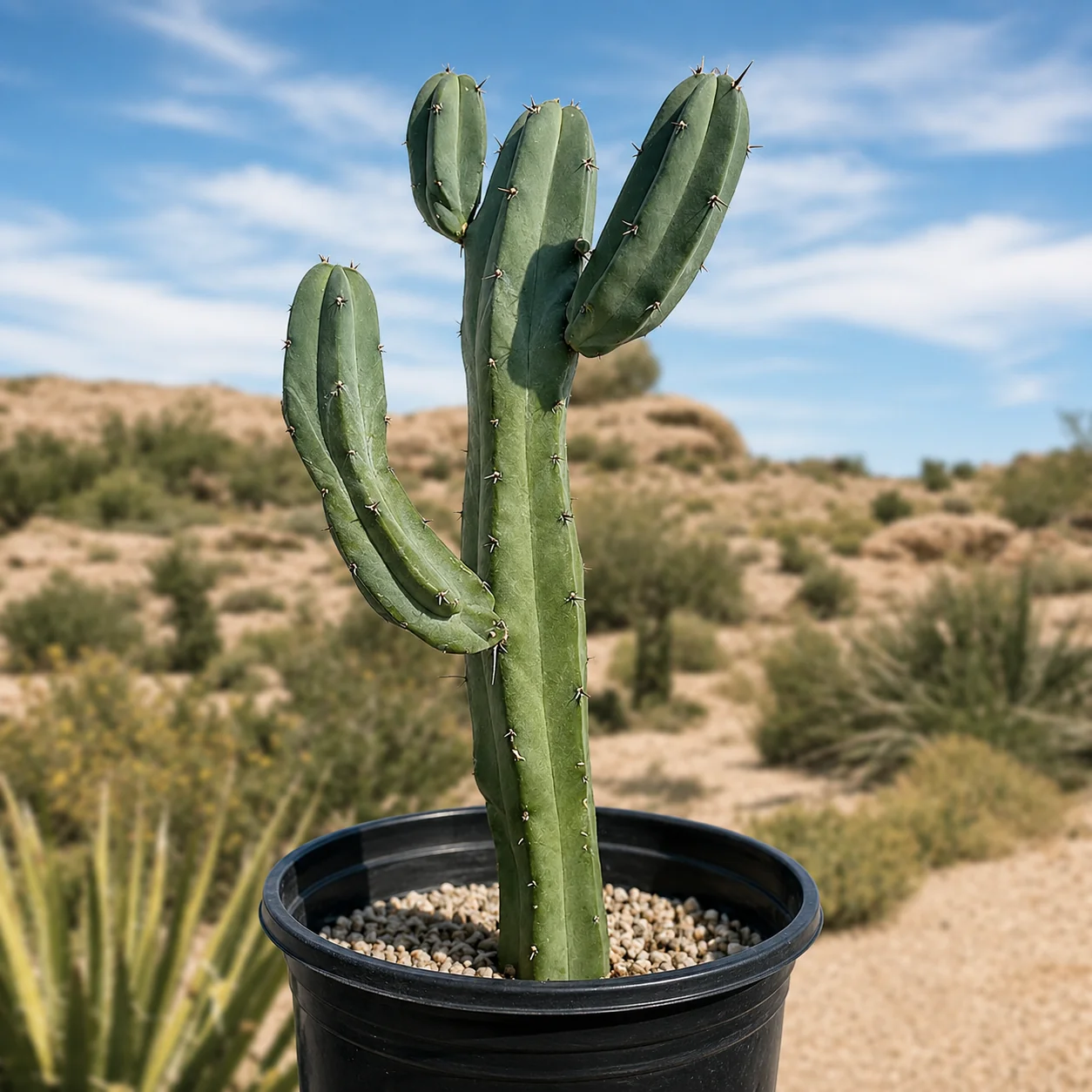
The Blue Flame Cactus (Myrtillocactus geometrizans) is a striking Mexican columnar cactus prized for its blue-green stems, geometric ribs, and increasingly architectural branching as it matures. Young plants begin with a relatively simple upright profile, but established specimens can develop multiple ascending branches that create the candelabra-like silhouette behind the name “Blue Flame.”
Its cool-toned surface and strong vertical form make it equally interesting as a container specimen and, where climate permits, a substantial landscape cactus.
For collectors drawn to blue cacti with genuine long-term presence, Myrtillocactus geometrizans offers far more than unusual coloration.
Myrtillocactus geometrizans — The Blue Flame Cactus
Blue Flame Cactus belongs to the family Cactaceae and is botanically identified as Myrtillocactus geometrizans.
The species is native to Mexico, where it grows in dry environments and can eventually develop into a large, tree-like cactus. Its mature architecture is very different from the solitary column suggested by many young nursery specimens.
Several common names are associated with the species, including:
- Blue Flame Cactus
- Blue Myrtle Cactus
- Blue Candle Cactus
- Bilberry Cactus
- Whortleberry Cactus
These names generally refer to the same species rather than separate cactus species.
For accurate identification, Myrtillocactus geometrizans is therefore the most useful name to look for.
Why Is Blue Flame Cactus Blue?
The blue coloration is one of the plant’s defining ornamental characteristics.
Its stems develop a glaucous blue-green to blue-gray surface, creating a cooler tone than the brighter greens found in many columnar cacti.
The effect can vary according to the individual plant, maturity, light conditions, and growing environment.
Avoid repeatedly rubbing or handling the stem surface unnecessarily. The natural surface bloom contributes to the cactus’s characteristic appearance, and handling can leave visible marks.
Against dark areoles and short spines, the blue-green stem color becomes particularly noticeable.
From a Single Column to a Candelabra
A young Blue Flame Cactus does not necessarily resemble a mature specimen.
Juvenile plants may consist primarily of a single upright stem or relatively simple growth. With maturity, Myrtillocactus geometrizans can branch repeatedly and develop the broad, tree-like or candelabra structure for which established plants are known.
The branches generally remain upright, producing a cluster of blue columns that can resemble flames or candles rising from the plant.
This transformation is one of the strongest reasons to grow the species.
You are not simply purchasing the appearance of the plant today—you are growing a cactus whose architecture can become considerably more complex with age.
How to Recognize a Blue Flame Cactus
Look beyond color alone when identifying the species.
Characteristic features include:
- upright blue-green to blue-gray stems;
- a glaucous surface;
- pronounced vertical ribs;
- relatively short spines emerging from regularly spaced areoles;
- increasingly branched growth on mature specimens;
- a candelabra-like form with age.
Established stems commonly develop five to eight ribs, contributing to the geometric appearance reflected in the species name geometrizans.
The combination of blue coloration, rib structure, short spination, and branching habit is more informative than any one characteristic by itself.
Blue Flame Cactus vs. Boobie Cactus
These plants are closely related but should not be treated as interchangeable.
The regular Blue Flame Cactus is Myrtillocactus geometrizans in its conventional ribbed form. It develops defined ribs and increasingly branched, columnar growth.
The Boobie Cactus is the unusual monstrose cultivar commonly identified as Myrtillocactus geometrizans ‘Fukurokuryuzinboku’.
Instead of maintaining regular ribs, the Boobie Cactus develops the exaggerated rounded protrusions responsible for its common name.
So although both share the same species background, their growth forms are dramatically different.
Choose Blue Flame when you want the clean geometric ribs, blue coloration, and branching candelabra architecture of the conventional species form.
Choosing a Blue Flame Cactus
A useful buying decision should consider more than the height of the plant.
Consider Its Current Structure
A single-column specimen offers a clean, architectural appearance and the opportunity to watch branching develop over time.
An established multi-branched plant provides more immediate candelabra character.
Neither form is inherently better—they represent different stages of development.
Look at the Color
Blue-green coloration is characteristic of the species, but exact intensity naturally varies.
Do not expect every living specimen to match an artificially uniform shade.
Plan for Future Growth
This is not naturally a miniature cactus.
Myrtillocactus geometrizans can become a substantial tree-like cactus under favorable outdoor conditions, so long-term space matters. Container culture and pruning can provide considerably more control where a smaller specimen is preferred.
Check the Individual Listing
Exact height, container size, number of branches, rooting status, propagation method, current flowering or fruiting status, and whether photographs show the exact specimen are inventory-specific details.
They should be confirmed from the individual product listing rather than inferred from general species information.
How Large Does Blue Flame Cactus Grow?
This species has significant mature potential.
In habitat, Myrtillocactus geometrizans can develop into a large, densely branched cactus several meters tall and wide. Botanical descriptions characterize mature plants as strongly branched and tree-like or candelabra-like.
Container-grown plants are much easier to maintain at a manageable scale.
That distinction is important for buyers.
A relatively compact nursery specimen may remain suitable for container cultivation for years, but its natural growth habit should still be considered when selecting a permanent location.
Give an outdoor specimen room to develop rather than positioning it according only to its current dimensions.
Flowers & Fruit
Mature Myrtillocactus geometrizans can produce relatively small greenish-white flowers.
These are followed by small, dark berry-like fruits under appropriate conditions. The fruiting characteristic is reflected in common names such as Bilberry Cactus and Whortleberry Cactus.
The flowers are comparatively subtle when considered against the scale of an established plant.
For ornamental cultivation, the cactus’s blue stems and mature branching structure remain its dominant visual features throughout the year.
Flowering or fruiting should not be assumed for a particular plant unless its current condition is specifically stated in the product listing.
How to Grow Blue Flame Cactus
Light
Provide abundant light.
Strong light supports compact growth and helps the plant maintain the appearance associated with healthy Myrtillocactus geometrizans.
If a newly acquired cactus has been grown under greenhouse shade or other protected conditions, increase direct sun exposure gradually rather than moving it immediately into intense sunlight.
Soil & Drainage
Use a porous cactus growing medium with excellent drainage.
The roots should not remain in saturated soil for extended periods.
Containers need functional drainage openings, and outdoor planting locations should avoid areas where water regularly accumulates around the root zone.
Watering
Water thoroughly when appropriate, then allow the growing medium to dry sufficiently before watering again.
Avoid keeping the soil continuously moist.
Water demand changes with temperature, season, sunlight, airflow, plant size, container size, and substrate composition. Checking actual growing conditions is therefore more reliable than using an inflexible weekly schedule.
During cooler periods and slower growth, moisture demand generally decreases.
Container Growing
Blue Flame Cactus works particularly well as a container specimen while young and moderately sized.
The upright growth creates considerable visual impact without requiring the horizontal spread of many sprawling succulents.
As the plant grows, however, stability becomes increasingly important.
A taller or branched specimen can become top-heavy, so the container should provide sufficient support while still allowing rapid drainage.
Repot according to root development and plant stability rather than automatically moving a small plant into an excessively large volume of soil.
Container cultivation is especially useful in climates where the cactus must be protected seasonally from cold.
Growing Blue Flame Cactus Outdoors
In warm, dry climates, Myrtillocactus geometrizans can become an impressive landscape specimen.
Its eventual branching form makes it suitable as a vertical accent or architectural focal point where sufficient space is available.
Drainage remains essential.
Cold is also an important consideration. This Mexican dryland species should not automatically be treated as a broadly frost-hardy cactus.
Growers in regions with significant winter freezes are generally better positioned to maintain manageable specimens in containers that can be moved into protection when necessary.
Natural Variation Between Plants
Living Blue Flame Cactus specimens will not be identical.
Natural variation may occur in:
- height;
- stem thickness;
- blue-green coloration;
- rib definition;
- spine development;
- number of branches;
- branching direction;
- overall symmetry;
- minor surface markings.
Age also has a major effect on appearance.
A young single column and an established candelabra-shaped specimen can look dramatically different while still belonging to the same species.
Exact dimensions and product-specific characteristics should therefore come from the individual listing.
Grow the Architecture, Not Just the Color
Blue Flame Cactus attracts attention because it is blue.
It becomes more interesting because it does not remain a simple blue column forever.
As Myrtillocactus geometrizans matures, new branches can transform its silhouette into an increasingly complex arrangement of upright stems. The glaucous surface emphasizes the geometry of the ribs, while short spines preserve a cleaner appearance than heavily armed columnar species.
That combination gives Blue Flame Cactus a clear identity within a collection: cool coloration, geometric structure, and architecture that becomes stronger with age.
Choose a Blue Flame Cactus when you want a specimen capable of developing from a straightforward young column into a substantial, branching centerpiece.
Frequently Asked Questions About Blue Flame Cactus
What is the scientific name of Blue Flame Cactus?
Blue Flame Cactus is Myrtillocactus geometrizans, an accepted cactus species native to Mexico.
Is Blue Flame Cactus the same as Blue Myrtle Cactus?
Yes. Blue Flame Cactus and Blue Myrtle Cactus are common names used for Myrtillocactus geometrizans. Blue Candle, Bilberry Cactus, and Whortleberry Cactus are also associated with the species.
Why is Blue Flame Cactus blue?
Its stems develop a glaucous, waxy-looking surface that creates the characteristic blue-green or blue-gray appearance.
Does Blue Flame Cactus branch?
Yes. Mature Myrtillocactus geometrizans is strongly branching and can eventually develop a tree-like, candelabra-shaped structure. Young plants may initially have much simpler growth.
Is Blue Flame Cactus the same as Boobie Cactus?
No. They share the same species background, but Boobie Cactus is a monstrose cultivated form with irregular rounded protrusions. Conventional Blue Flame Cactus maintains the more regular ribbed structure of Myrtillocactus geometrizans.
Can Blue Flame Cactus grow indoors?
Yes, particularly while it is manageable as a container specimen. Provide abundant light, excellent drainage, appropriate watering, and enough vertical space for continued development.
How often should Blue Flame Cactus be watered?
There is no reliable universal schedule. Water according to the plant’s growing conditions and allow the substrate to dry appropriately between waterings rather than keeping the root zone continuously wet.
Does Blue Flame Cactus flower?
Mature plants can produce relatively small greenish-white flowers, followed by berry-like fruits under suitable conditions. Flowering depends on maturity and growing conditions.
| Size | 12"-14" Tall Plant, 15"-18" Tall Plant, 24" Tall Plant, 36" Tall Plant, Specimen A, Specimen B, Specimen C |
|---|
Be the first to review “Blue Flame Cactus”
Related products
Cactus for sale
SAN PEDRO DRIED SKIN / 30GR AT 2KG / – (TRICHOCEREUS PACHANOI CACTUS) HUACHUMA WACHUMA ECHINOPSIS
Cactus for sale
Cactus for sale

Cactus for sale
SAN PEDRO / 30GR AT 1KG / – (TRICHOCEREUS / ECHINOPSIS PACHANOI) HUACHUMA – CAPTUS POWDER
Cactus for sale
San Pedro Pachanoi (Trichocereus) In Pot Large 25 CM – 40 CM
Cactus for sale
Cactus for sale
Cactus for sale
Reviews
There are no reviews yet.